Opinion & Analysis
Zero-Page Websites: Websites Without Pages
AI agents are learning to navigate our websites. What happens when businesses stop making them?

Your listening Queue & catch up
Add a story or build a catch-up queue to start listening.
An AI agent booking a restaurant table does not need to admire the restaurant’s homepage. It needs to know what is available, what the booking requires and whether the reservation succeeded.
Yet we are teaching agents to navigate much of the internet as though they were people: interpreting layouts, locating controls and moving between screens. It is an impressive way to make existing websites usable by software. It may also be a bridge to something simpler.
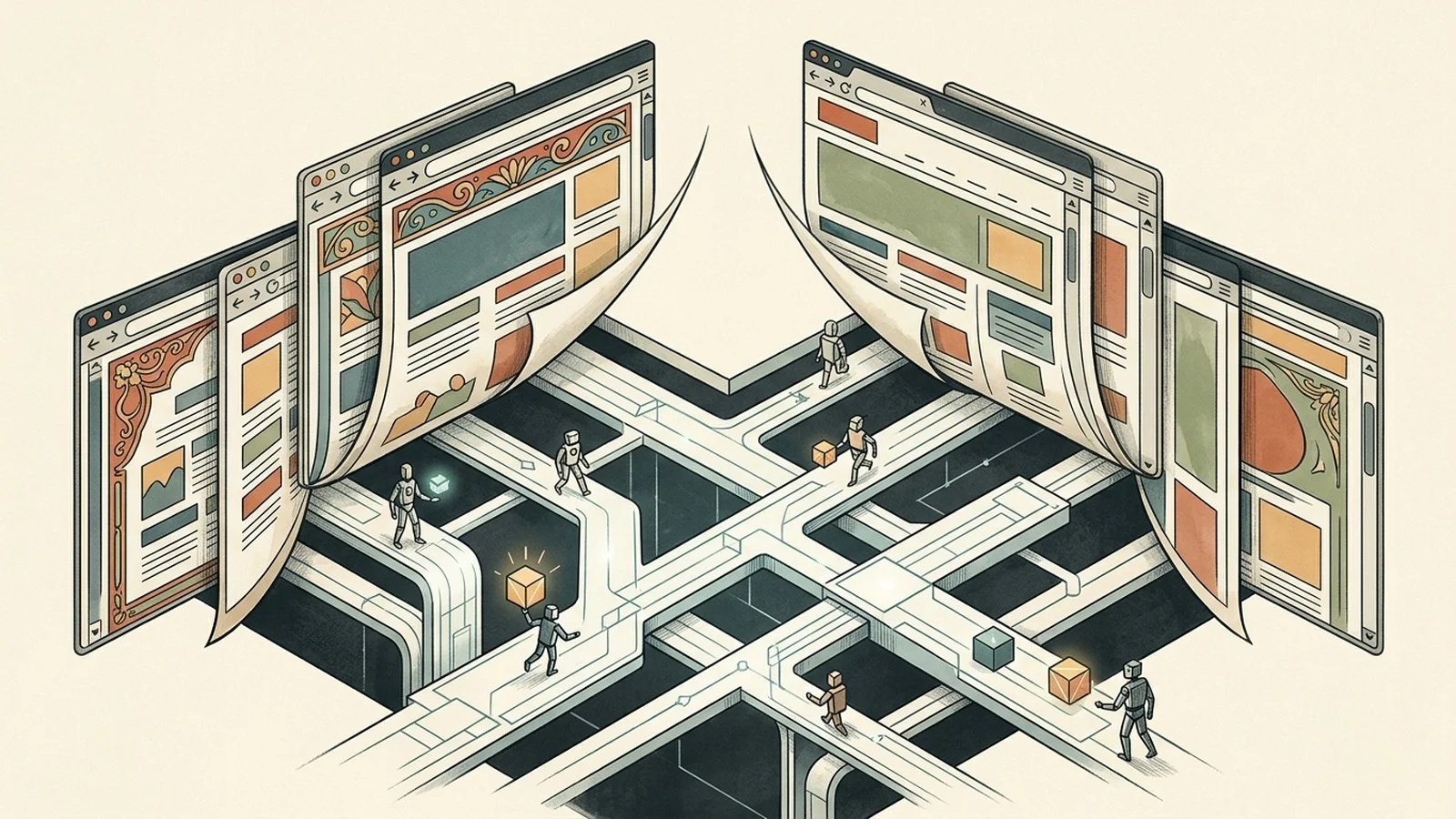
Call it a zero-page website: an online service that an agent can discover, understand and use without navigating human-facing pages.
The business remains. The information remains. The transaction remains. For the agent, the pages become optional.
Manufacturing offers a useful analogy. In lights-out production, machines can work without continuous human attendance. A case study from robotics supplier FANUC describes workers at KAD Models preparing machining jobs during the day, then returning to parts produced by automated cells overnight.
The lesson is that automation changes what the working environment needs to provide. Online, an agent may have little use for a storefront designed around human attention.
The prospective visitors are already arriving. Meta’s Muse operates on a dedicated virtual computer with its own browser. Grok Bot gives agents a persistent cloud computer for work across apps and websites. OpenAI’s dots are always-on agents that work across connected tools. Perplexity’s Comet Assistant brings delegated tasks into the browser. Their capabilities and access differ, but they make the prospect of software acting as a customer’s representative increasingly concrete.
Browsers are a sensible starting point. They let agents work with services that have never been connected to them. Nobody has to wait for every restaurant, retailer or municipal office to adopt a new standard.
But compatibility has a cost. The agent may have to reconstruct a straightforward operation from a sequence of visual clues, introducing additional processing and opportunities for error. A changed layout can alter that route even when the underlying service is unchanged.
I encountered a different kind of friction while asking Muse to help me with a task inside Facebook. It said it could help. About an hour later, the task remained unfinished; I subsequently found my account locked and spent several days regaining access. I do not know what triggered the restriction or whether the agent caused it. The experience left me thinking about how an agent’s activity is recognized and authorized.
A zero-page service could make the requested operation explicit. For a restaurant reservation, an agent would submit a date, party size and preferred time, receive available choices, then confirm the selected booking. It would get a verifiable confirmation rather than having to infer success from a page.
Developers will recognize the obvious objection: this sounds like an application programming interface. In large part, it is.
APIs already let software exchange data and perform actions. The proposed shift is toward making a complete service accessible to agents beyond individually engineered integrations. The agent would need to find the service, understand its terms, obtain permission and receive a verifiable result.
“Zero-page” describes that experience. It does not require a new protocol or a new name for every existing API.
Work in this direction predates the phrase. A June 2025 position paper advocated web interfaces designed specifically for agents. Nigel Dalton, Kate Linton and Karen Davis subsequently explored the manufacturing analogy in an essay about a “lights-out web.”
WebMCP, a proposed web standard described in Google’s Chrome documentation, offers an intermediate step: websites can expose structured tools that explicitly describe available operations. It works within pages, illustrating how human and agent interfaces can develop together.
Removing pages would not remove responsibility. A service must know whose authority an agent holds. Permission to check appointments should not imply permission to cancel them. A failed connection must not turn a repeated request into two purchases. Users need clear terms, control over consequential decisions and records they can inspect.
Nor would direct access automatically make agents correct. They could still misunderstand a request or choose the wrong action. What changes is how much they must infer about operating the service.
Commercial incentives may be harder to align than the technology. Businesses may welcome automated purchases while resisting agents that bypass promotions and compare competitors. Publishers still need reporting to be funded when an assistant delivers information without a reader visiting. Access and payment will require agreements.
I expect a mixed web. People will continue to browse shops, read publications and discover things they did not know to ask for. Businesses may maintain rich websites for those visits while offering agents a zero-page route to the same services. Some businesses may eventually find that the agent entrance is enough.
There will still be interfaces for people to review choices and results. Those interfaces may belong to their assistants, rather than every business they deal with.
We have spent decades designing websites around the visit. Agents invite us to design services around the task.
A zero-page website would succeed when the customer gets what they asked for without the agent ever having to turn it into a browsing session.
Comments (0)
No comments yet. Be the first to share a thought on this story.